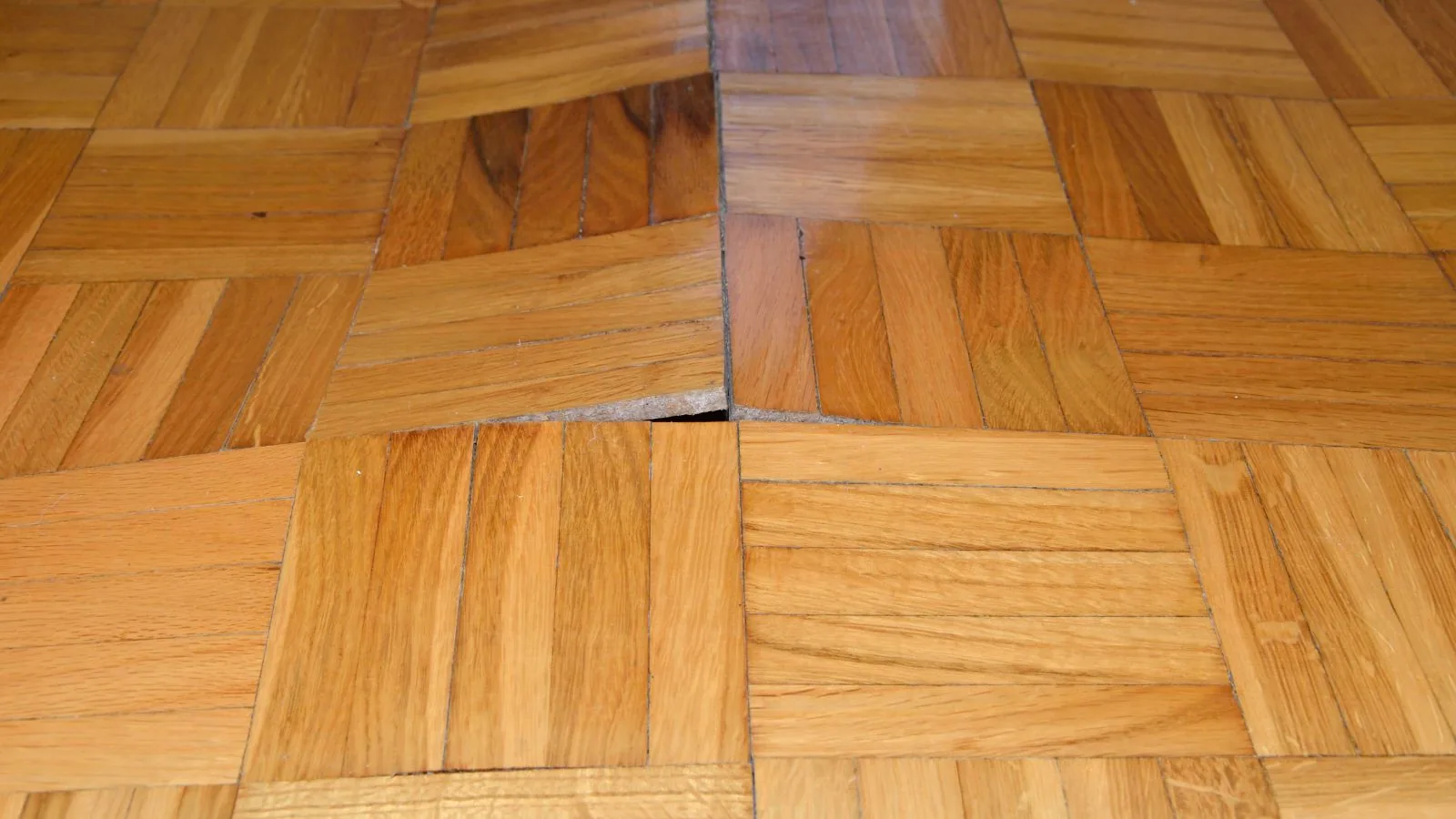
Hardwood absorbs water through its edges and underside and swells as it does. If a leak or flood has wet your floor, remove standing water and call. Our emergency line is open 24/7, and early drying often decides whether the floor is saved.
What water does to hardwood floors
Cupping
Board edges rise higher than the center as the underside absorbs moisture.
Crowning
The center rises after a cupped floor is sanded while still damp.
Buckling
Boards lift off the subfloor, often from a flood or a very wet subfloor.
Staining and blackening
Water left on the surface leaves gray or dark marks that reach the finish.
Can a water-damaged hardwood floor be saved?
The answer depends on how long the boards stayed wet, how deep the water got and the type of flooring. Solid hardwood often recovers if it is dried promptly and slowly. Engineered flooring with a thin veneer may delaminate. Floors wet for days often develop permanent warping or dark stains.
In an older home with original solid hardwood, boards are thicker and can often be sanded and refinished after drying. Fast action improves those odds.
What to do first when hardwood gets wet, and how we dry it
- Remove surface water. Extractors and fans clear the top of the floor.
- Create airflow under and over. Air movers and, where possible, floor-drying mats pull moisture out through the board.
- Dehumidify the room. Low humidity helps the boards release water gradually.
- Monitor and decide. Readings guide whether to sand, repair or replace sections.
Drying, repair or replacement: how the decision is made
| Condition | Likely path | Notes |
|---|---|---|
| Light cupping after fast drying | Dry and wait, then refinish | Boards often flatten as they dry |
| Buckling | Replace affected boards | Boards have separated from the subfloor |
| Black or gray staining | Sand, bleach or replace | Depends on how deep the stain goes |
| Engineered floor delaminating | Replace | Veneer layers have separated |
What affects the cost of hardwood floor water damage repair
Price depends on how much floor is affected, whether the boards are solid or engineered, how much is replaced and whether sanding and refinishing are needed. We explain the scope and price before work starts.
Solid, engineered and laminate floors respond differently
| Floor type | Reaction to water | Typical outcome |
|---|---|---|
| Solid hardwood | Cups or buckles as it swells | Often saved if dried quickly |
| Engineered hardwood | Layers can separate | Often replaced if soaked |
| Laminate | Core swells and edges lift | Usually replaced |
| Pre-finished boards | Seams trap water | Dried and reassessed |
Laminate is not hardwood, though it is often confused with it. It rarely recovers from heavy wetting. Ask us if you are unsure which type you have.
Sanding and refinishing after drying
Once the floor is dry and flat, sanding removes stains and the damaged finish. A new stain and coats of finish bring the color back to match. Sanding too soon, before boards stabilize, is the most common reason a floor warps again.
In an older house with wide solid boards, a floor can usually be sanded more than once, which makes recovery more likely.
Insurance note for hardwood floors
Insurers often want to see the damage before boards are removed. Photograph the floor, record moisture readings if possible and read your policy before repairs begin.
Floors dry together with the rooms around them. See structural drying, and water extraction for removing the first water. For basement and slab sources, read slab leak water damage. For other flooring, see carpet water damage restoration.
ANSI/IICRC S500 is the published standard that guides drying wood floors and subfloors. Moisture readings, not appearance, show when a floor is ready for finishing.
Hardwood floor questions
As fast as possible, within the first day or two. The EPA advises drying wet materials within 24 to 48 hours to limit mold growth.
No. Wait until the boards are fully dry and flat. Sanding a damp cupped floor can lead to crowning.
Often it does when drying is prompt. If boards stay warped after the readings are normal, they are replaced.
Yes. The line is open 24/7.